
Blog
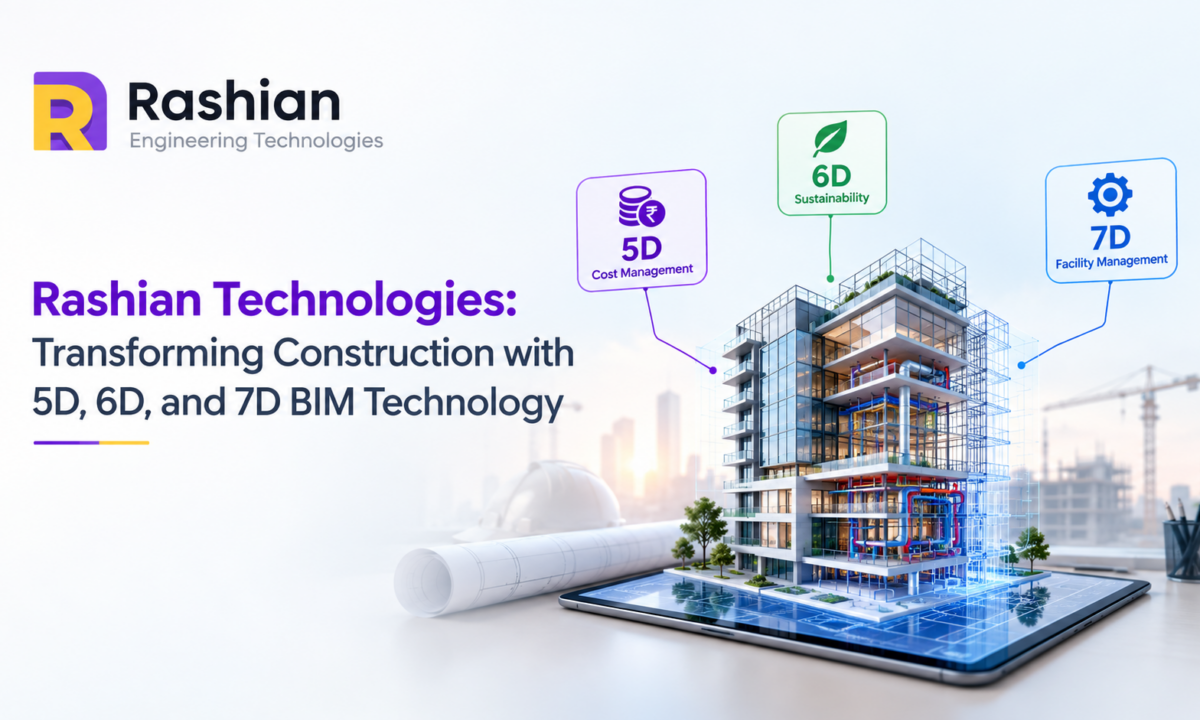
Rashian Technologies: Transforming Construction with 5D, 6D, and 7D BIM Technology
The construction industry is experiencing a major transformation through digital technologies that improve project planning, design coordination, cost management, sustainability, and building maintenance. Building Information Modeling (BIM) has become an important part of this transformation by enabling construction professionals to create and manage detailed digital representations of buildings and infrastructure projects. As construction projects become more complex, advanced BIM dimensions such as 5D 6D and 7D BIM Technology are helping organizations improve efficiency, reduce errors, and achieve better project outcomes.
Rashian Technologies recognizes the importance of modern digital construction practices in delivering smarter, more coordinated, and cost-effective construction solutions. By adopting advanced BIM workflows, construction companies can connect project design, budgeting, sustainability planning, and facility management within a more integrated digital environment.
Understanding 5D, 6D, and 7D BIM technology helps developers, architects, engineers, contractors, and facility managers make informed decisions throughout a building’s lifecycle.
What Is Building Information Modeling (BIM)?
Building Information Modeling, commonly known as BIM, is a digital process used to create, manage, and share information about a building or infrastructure project. Unlike traditional two-dimensional drawings, BIM combines three-dimensional models with relevant project information, including dimensions, materials, specifications, quantities, and performance data.
BIM supports collaboration among architects, structural engineers, MEP engineers, contractors, quantity surveyors, and other project stakeholders. When teams work with coordinated information, they can identify design conflicts earlier, improve communication, and minimize costly changes during construction.
BIM is commonly explained through different dimensions, each introducing additional information or management capabilities to the project model.
- 3D BIM: Represents the physical geometry and spatial relationships of a building.
- 4D BIM: Connects the 3D model with construction scheduling and project timelines.
- 5D BIM: Integrates cost estimation, quantities, and budget management.
- 6D BIM: Commonly focuses on sustainability, energy performance, and building lifecycle performance.
- 7D BIM: Commonly supports facility management, maintenance, and asset information.
The exact meaning of the 6D and 7D labels can vary by organization and BIM standard. Their primary purpose is to extend the usefulness of digital building information beyond design and construction.
Understanding 5D BIM Technology
What Is 5D BIM?
5D BIM is an advanced Building Information Modeling approach that connects a 3D building model and construction schedule with cost and quantity information. It enables project teams to understand how design decisions affect estimated costs and overall budgets.
Traditional cost estimation often relies on separate spreadsheets, quantity takeoffs, and drawing measurements. These processes can become time-consuming, particularly when designs change frequently. 5D BIM helps connect model elements with quantity and cost data, allowing teams to update estimates more efficiently when the model changes.
Key Benefits of 5D BIM
1. Accurate Cost Estimation
5D BIM supports quantity takeoffs and cost estimation using information associated with model elements. When model quantities are correctly configured and reviewed, estimators can develop more consistent project budgets and identify potential cost differences earlier.
2. Improved Budget Control
Construction teams can compare estimated costs with approved budgets and evaluate the financial implications of proposed design changes. This makes it easier to identify cost overruns and take corrective action before they become significant problems.
3. Faster Quantity Takeoffs
Manually measuring quantities from drawings can require considerable effort. BIM-based quantity extraction can reduce repetitive work and help quantity surveyors prepare estimates more efficiently. Human review remains important to confirm measurement rules, exclusions, and pricing assumptions.
4. Better Decision-Making
Project stakeholders can compare alternative materials, construction methods, and design options based on their estimated costs. This helps teams balance quality, functionality, and affordability.
5. Reduced Material Waste
Better quantity planning can help contractors estimate material requirements more effectively. When combined with appropriate procurement and site management practices, this can reduce unnecessary purchases and material waste.
Applications of 5D BIM
5D BIM is particularly useful for residential developments, commercial buildings, industrial facilities, hospitals, educational institutions, and infrastructure projects. It supports quantity surveying, tender preparation, procurement planning, cost forecasting, and financial reporting.
For construction projects managed using digital workflows, Rashian Technologies can highlight the importance of connecting model information with reliable cost data to support more informed project planning.
Understanding 6D BIM Technology
What Is 6D BIM?
6D BIM commonly extends the BIM model to support sustainability, energy efficiency, environmental performance, and lifecycle-related decision-making. It helps project teams evaluate how building design choices may affect energy consumption, resource use, operational costs, and environmental impact.
In many projects, sustainability decisions made during the design stage can influence the building’s long-term performance. BIM-based workflows provide a structured way to organize information that supports these decisions.
However, 6D BIM is not limited to a single software application or universally fixed definition. Its implementation depends on project requirements, the information being managed, and the standards adopted by the project team.
Key Benefits of 6D BIM
1. Improved Energy Efficiency
6D BIM workflows can incorporate information related to building orientation, insulation, glazing, lighting, HVAC systems, and other factors that influence energy performance. When connected to appropriate energy analysis tools, this information helps teams evaluate design alternatives.
2. Sustainable Material Selection
Project teams can assess material options based on factors such as durability, expected service life, embodied carbon, and environmental impact. Reliable product data and suitable assessment methods are essential for meaningful comparisons.
3. Reduced Environmental Impact
Sustainability analysis can help identify opportunities to reduce energy consumption, water usage, material waste, and greenhouse gas emissions. These improvements depend on design choices, construction practices, and the building’s actual operating conditions.
4. Lifecycle Cost Awareness
A building’s expenses extend beyond initial construction. Energy bills, routine maintenance, equipment replacement, and other operating costs can significantly influence its total cost over time. Lifecycle-focused BIM workflows help stakeholders consider these factors during planning.
5. Support for Green Building Goals
6D BIM can contribute to sustainability objectives and support the collection of information needed for green building assessments. Achieving a particular certification or performance target still requires compliance with the relevant assessment framework.
Applications of 6D BIM
6D BIM can be useful for energy-efficient commercial buildings, hospitals, educational campuses, industrial facilities, residential developments, and environmentally focused infrastructure projects.
For example, a commercial building project may compare different glazing systems, insulation materials, lighting configurations, and HVAC options. By combining BIM information with energy analysis, project teams can assess potential performance differences before construction begins.
For Rashian Technologies, 6D BIM represents an opportunity to communicate the value of integrating digital design information with sustainability and lifecycle performance objectives.
Understanding 7D BIM Technology
What Is 7D BIM?
7D BIM commonly focuses on facility management and asset management after construction is completed. It extends the value of the digital building model into the operational phase by organizing information that building owners and facility managers need to maintain their properties and equipment.
A completed building contains many assets, including elevators, air-conditioning systems, pumps, electrical panels, fire protection systems, lighting equipment, and plumbing components. Managing these assets effectively requires accurate records, maintenance schedules, warranties, and equipment information.
7D BIM workflows can connect these details with relevant model elements or asset records, making building information easier to access throughout the operational lifecycle.
Key Benefits of 7D BIM
1. Efficient Facility Management
Facility managers can use structured asset information to identify equipment locations, review specifications, access documentation, and organize maintenance activities. The usefulness of the system depends on the completeness and accuracy of the information provided.
2. Preventive Maintenance Planning
7D BIM can support preventive maintenance by connecting equipment records with recommended servicing intervals, warranty details, and maintenance documentation. When integrated with suitable maintenance systems, it can help teams plan inspections and service activities more effectively.
3. Improved Asset Tracking
Building owners can maintain organized records of installed equipment, including manufacturer details, model numbers, serial numbers, installation dates, and expected service lives.
4. Reduced Operational Costs
Better asset information can reduce the time spent locating documents and identifying equipment. Organized maintenance planning may also help avoid unnecessary repairs, unexpected downtime, and premature equipment replacement.
5. Better Handover Documentation
At project completion, contractors can provide building owners with structured information about installed systems, warranties, operating instructions, and maintenance requirements. This supports a smoother transition from construction to facility operations.
Applications of 7D BIM
7D BIM is valuable for hospitals, airports, office complexes, shopping malls, hotels, manufacturing facilities, residential communities, and other properties with extensive building systems.
For example, a hospital facility manager may need to locate an air-handling unit, check its maintenance history, and review manufacturer instructions. A well-maintained BIM-based asset information system can make these tasks easier by connecting equipment information with relevant building locations.
For Rashian Technologies, 7D BIM provides a way to demonstrate how digital construction information can remain useful long after a project has been completed.
5D vs. 6D vs. 7D BIM: Key Differences
Although these BIM dimensions can work together, each supports a different set of project objectives.
| BIM Dimension | Primary Focus | Main Benefits |
|---|---|---|
| 5D BIM | Cost and quantity management | Budget planning, cost estimation, quantity takeoffs |
| 6D BIM | Sustainability and lifecycle performance | Energy analysis, environmental planning, operational efficiency |
| 7D BIM | Facility and asset management | Maintenance planning, asset tracking, building operations |
When integrated effectively, these capabilities help project teams connect financial decisions, environmental objectives, and long-term operational requirements.
How 5D, 6D, and 7D BIM Work Together
The greatest value of advanced BIM comes from treating project information as a connected resource rather than a collection of separate documents.
Consider a new commercial office building.
During planning, 5D BIM helps the project team estimate quantities and evaluate the financial implications of different design options. This supports budgeting and cost control.
During sustainability planning, 6D BIM workflows help evaluate energy performance, material selection, and lifecycle considerations. The team can use these insights to make more informed design decisions.
After construction, 7D BIM supports the management of installed equipment, warranties, maintenance schedules, and asset records. Facility managers can use this information to maintain building systems and plan future replacements.
When these workflows are coordinated with 3D modeling and 4D scheduling, stakeholders gain a more comprehensive understanding of the project from initial design through construction and operation.
Challenges in Implementing Advanced BIM
Despite its benefits, implementing 5D, 6D, and 7D BIM requires careful planning.
Initial investment: BIM implementation may involve software licensing, hardware, training, consultancy, and process development.
Data quality: Inaccurate quantities, incomplete asset records, and inconsistent model information can affect the reliability of project outputs.
Team collaboration: Architects, engineers, contractors, and facility managers need agreed processes for sharing information and managing changes.
Skills and training: Teams require appropriate technical knowledge to create, coordinate, validate, and maintain BIM information.
Software interoperability: Different tools may use different data formats and workflows. Open standards and clearly defined exchange requirements can help reduce information loss.
Lifecycle information management: Building owners must establish who is responsible for updating asset information after handover.
Addressing these challenges requires a clear BIM execution plan, defined information requirements, appropriate training, and quality-control procedures.
The Future of BIM Technology in Construction
The future of BIM is closely connected to emerging digital technologies such as artificial intelligence, digital twins, cloud collaboration, Internet of Things sensors, and advanced analytics.
Artificial intelligence may help teams identify patterns in project information, detect potential coordination issues, and support forecasting. Digital twins can connect building models with operational data to provide insights into real-world performance. IoT sensors can supply information about equipment condition, temperature, energy consumption, and system performance.
Cloud-based collaboration platforms can also improve access to current project information across geographically distributed teams.
These technologies are most effective when built on reliable data, clearly defined processes, and appropriate security measures. As digital construction practices evolve, 5D, 6D, and 7D BIM are expected to remain important components of integrated project and asset information management.
Why Advanced BIM Matters for Rashian Technologies
For organizations working in construction, engineering, and digital project delivery, advanced BIM offers a framework for improving the way building information is created, shared, and used.
Rashian Technologies can position 5D 6D and 7D BIM Technology as important areas of digital construction innovation by emphasizing the value of cost transparency, sustainability-focused planning, and organized facility information.
These technologies can help project stakeholders understand the financial impact of design decisions, evaluate building performance, and prepare reliable information for ongoing operations.
Successful implementation requires more than producing a detailed 3D model. It involves connecting accurate data with practical business objectives, ensuring collaboration between project teams, and maintaining information throughout the building lifecycle.
By understanding these principles, construction professionals can make better-informed decisions and work toward more efficient, sustainable, and manageable projects.
Conclusion
5D 6D and 7D BIM Technology are extending the role of Building Information Modeling beyond three-dimensional design. 5D BIM supports cost estimation and budget management, 6D BIM commonly supports sustainability and lifecycle performance, and 7D BIM commonly supports facility and asset management.
Together, these capabilities help connect construction planning with financial control, environmental considerations, and long-term building operations. Although successful implementation requires investment, reliable data, collaboration, and technical expertise, the potential benefits make advanced BIM an important part of modern construction.
Rashian Technologies: Transforming Construction with 5D, 6D, and 7D BIM Technology reflects the growing importance of digital innovation in building smarter, more sustainable, and better-managed infrastructure for the future.