

Blog
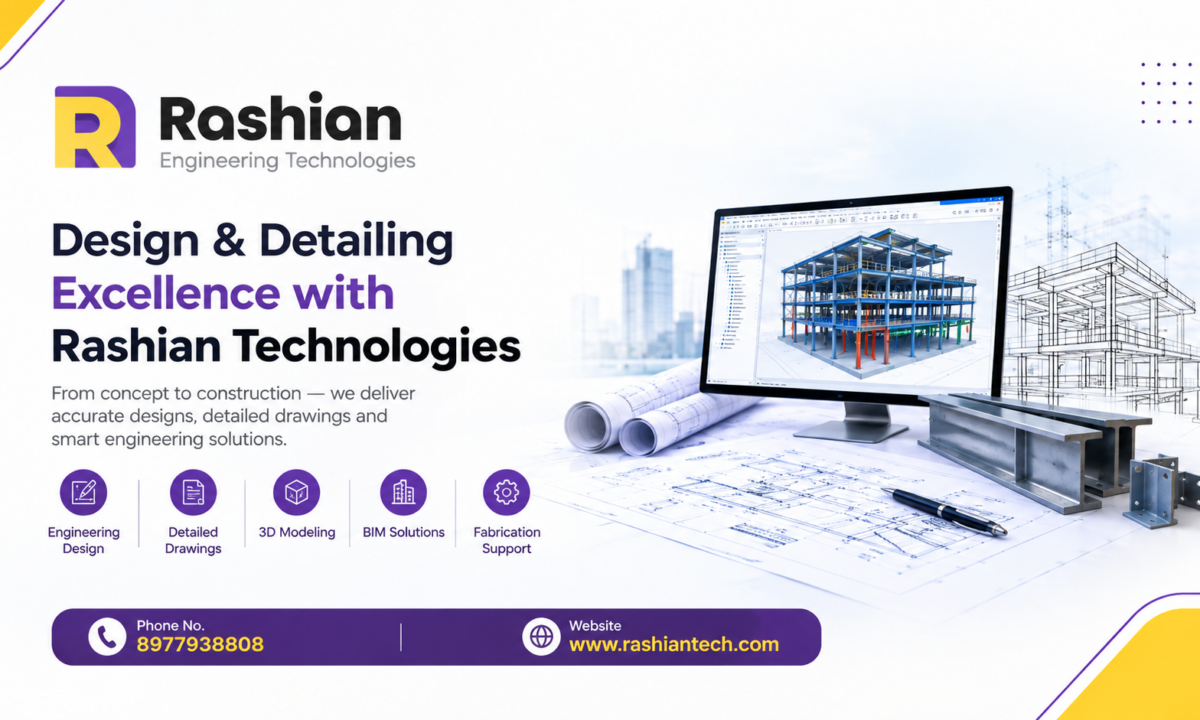
Design & Detailing Excellence with Rashian Technologies
Design and Detailing Services , In the modern construction and engineering industry, successful projects depend on more than just good ideas. Accurate engineering design and detailing play a crucial role in transforming concepts into practical, buildable, and efficient structures. From structural drawings and fabrication details to 3D modeling and project documentation, every stage requires precision and technical expertise.
Rashian Technologies focuses on providing professional engineering design and detailing solutions that help construction and fabrication projects achieve better coordination, accuracy, and execution. By combining engineering knowledge, advanced software, and attention to detail, design teams can support projects from the initial concept through fabrication and installation.
What Is Engineering Design and Detailing?
Engineering design is the process of developing technical solutions based on project requirements, engineering principles, specifications, and applicable standards. It establishes how a structure or component should be designed to meet functional and performance requirements.
Engineering detailing takes the design a step further. It converts engineering concepts into detailed drawings and documentation that can be used by fabricators, contractors, and site teams.
A typical workflow may include:
- Understanding project requirements
- Preparing engineering designs
- Developing 2D drawings
- Creating 3D models
- Preparing fabrication drawings
- Developing connection details
- Creating shop drawings
- Preparing material and quantity information
- Coordinating different engineering disciplines
- Reviewing drawings for accuracy
- Supporting fabrication and construction
When design and detailing are properly coordinated, they can reduce confusion and improve communication throughout the project.
The Importance of Accurate Design
Every construction project begins with a concept. However, that concept needs to be converted into technical information before construction can begin.
Accurate design helps establish important project parameters such as dimensions, materials, structural requirements, loads, connections, and component arrangements.
A well-developed design can help project teams:
- Understand technical requirements clearly
- Improve planning and coordination
- Reduce design conflicts
- Support accurate material estimation
- Improve fabrication planning
- Reduce unnecessary modifications
- Maintain project documentation
- Support construction activities
Design accuracy is particularly important for complex projects where multiple components and disciplines must work together.
Why Detailing Matters in Construction
Engineering detailing connects design with actual project execution.
A structural concept may show the overall arrangement of a building or component. However, fabricators and site teams need more detailed information to manufacture and assemble individual elements.
Detailed drawings may include:
- Exact dimensions
- Material specifications
- Connection information
- Component identification
- Assembly details
- Welding information
- Bolt details
- Section views
- Elevations
- Fabrication requirements
- Installation references
Good detailing makes technical information easier to understand and use during fabrication and construction.
Rashian Technologies and Design Excellence
Rashian Technologies provides engineering design and detailing solutions with a focus on accuracy, coordination, and practical project requirements.
The company can support different stages of engineering workflows, depending on project requirements. Using digital design tools and structured processes, engineering information can be developed into drawings and models that support project execution.
The objective is not simply to produce drawings. Effective engineering documentation should communicate technical information clearly so that different project stakeholders can work from a consistent set of information.
3D Modeling for Better Visualization
3D modeling has become an important part of modern engineering workflows. Unlike traditional 2D drawings, a three-dimensional model allows project teams to visualize components and their relationships within the overall structure.
3D models can help teams identify:
- Spatial conflicts
- Component locations
- Connection arrangements
- Structural relationships
- Installation requirements
- Coordination issues
For complex projects, visualization can make technical discussions easier because engineers, fabricators, contractors, and clients can review the same digital representation.
BIM and Engineering Detailing
Building Information Modeling, commonly known as BIM, provides a digital approach to managing project information.
BIM models can contain geometric and technical information about building components. When properly coordinated, they can support communication between different disciplines.
For example, structural, architectural, and MEP information can be coordinated within a project workflow. This can help identify potential clashes before work reaches the construction site.
BIM-based detailing can also support:
- Model-based coordination
- Quantity information
- Drawing generation
- Design reviews
- Project visualization
- Documentation
- Construction planning
For projects involving multiple teams, coordinated digital information can be particularly valuable.
Structural Design and Detailing
The structural design and detailing require careful consideration of loads, materials, connections, dimensions, and construction requirements.
structural detailing may involve elements such as:
- Beams
- Columns
- Bracing systems
- Steel connections
- Base plates
- Stairs
- Platforms
- Structural frames
- Miscellaneous steel
Each component needs appropriate technical information for fabrication and installation.
Accurate structural detailing can help fabricators understand how individual components should be manufactured and assembled according to the engineering design.
Fabrication Drawings
Fabrication drawings provide detailed information required for manufacturing structural components.
These drawings can contain dimensions, material specifications, connection details, welding information, and component identification.
Clear fabrication drawings can help reduce misunderstandings between engineering and fabrication teams. They can also provide a useful reference during quality checks and assembly.
For steel structures and prefabricated components, fabrication documentation is an important part of the overall project workflow.
Shop Drawings and Construction Documentation
Shop drawings provide detailed information about how specific components are to be manufactured or installed.
Depending on the project, shop drawings may cover structural steel, architectural elements, mechanical components, or other fabricated systems.
Well-organized documentation can help project teams:
- Review component details
- Coordinate fabrication
- Verify dimensions
- Understand installation requirements
- Track revisions
- Communicate technical changes
Maintaining accurate revision information is also important because construction projects can involve multiple design updates.
How Design and Detailing Improve Project Efficiency
Engineering design and detailing can influence project efficiency in several ways.
1. Better Communication
Clear drawings and models provide a common reference for engineers, fabricators, contractors, and site teams.
2. Reduced Errors
Accurate documentation can help identify mistakes before fabrication or construction begins.
3. Better Material Planning
Detailed information can support material estimation and procurement planning.
4. Improved Fabrication
Fabricators can use detailed drawings to understand component dimensions and connections.
5. Easier Coordination
Digital models and coordinated drawings can help teams identify conflicts between different systems.
6. Improved Documentation
Organized engineering documents provide a record of design decisions, revisions, and project requirements.
The Role of Technology in Modern Engineering
Technology has transformed the way engineering projects are designed and documented. Software applications now allow engineering teams to create accurate drawings, detailed models, and coordinated project information.
Digital engineering workflows can improve the speed and consistency of design documentation. They can also make it easier to review and modify project information.
However, software alone does not guarantee a successful design. Technical knowledge, engineering judgment, project understanding, and careful review remain essential.
This combination of technology and engineering expertise is important for delivering reliable design and detailing services.
Quality Control in Design and Detailing
Quality control is an important part of engineering documentation.
Before drawings are issued, they may need to be reviewed for:
- Dimensional accuracy
- Drawing consistency
- Connection information
- Material specifications
- Model coordination
- Revision details
- Drawing references
- Project standards
- Client requirements
A structured checking process can help identify issues before drawings reach fabrication or construction teams.
Supporting Different Project Stages
Engineering Design and Detailing Services can contribute throughout the project lifecycle.
During the design stage, engineers develop concepts and technical solutions.
detailing stage, those concepts are converted into detailed drawings and models.
fabrication stage, drawings provide information required for manufacturing.
construction stage, documentation supports installation and coordination.
project revisions, updated drawings and models can help teams manage design changes.
This makes engineering detailing an important link between design, fabrication, and construction.
Why Choose Rashian Technologies?
Rashian Technologies aims to provide engineering design and detailing solutions that focus on technical accuracy, project coordination, and practical execution.
The approach can combine:
- Engineering expertise
- Digital design technologies
- 2D drafting
- 3D modeling
- BIM workflows
- Detailed documentation
- Quality checking
- Project coordination
By understanding project requirements and developing structured technical documentation, design teams can support smoother communication between different stakeholders.
Future of Engineering Design and Detailing
The future of engineering design is increasingly digital. BIM, 3D modeling, automation, cloud-based collaboration, and data-driven workflows are becoming important components of modern construction and engineering.
As projects become more complex, the need for coordinated and accurate technical information will continue to grow.
Future engineering workflows are likely to place greater emphasis on:
- Digital collaboration
- Intelligent 3D models
- Automated documentation
- Clash detection
- Data integration
- Real-time project coordination
- Digital project records
Companies that combine engineering expertise with modern technology can support this transition toward more connected project delivery.
Conclusion
Design and Detailing Services are essential components of successful engineering and construction projects. While design establishes the technical foundation, detailing converts that foundation into practical information that can be used for fabrication, coordination, and construction.
With modern software, 3D modeling, BIM workflows, and engineering expertise, Rashian Technologies supports the development of accurate and organized engineering documentation.
From structural design and fabrication drawings to BIM modeling and detailed project documentation, a strong design and detailing process can help improve communication, coordination, and project execution.
For organizations looking for professional engineering design and detailing services, Rashian Technologies can support projects with a combination of technical knowledge, digital tools, and attention to detail.